

“DA Leader, Mmusi Maimane, explains why the DA chose to reject President Jacob Zuma’s offer to settle his Nkandla debt out of court “
Tag: GoZA

Nkandla: DA to proceed with arguments before the ConCourt (03.02.2016)

These are the remarks delivered at a press conference held in Parliament. The Leader was joined by the Chairperson of the DA’s Federal Executive, James Selfe MP, and DA shadow Minister of Justice, Adv Glynnis Breytenbach MP.
The DA, after taking legal advice, has decided to proceed with presenting our Heads of Argument before the Constitutional Court scheduled for Tuesday, 09 February 2016. In so doing we will be seeking the relief outlined in our Notice Of Motion.
The DA notes the settlement offer made by President Zuma but contends that the contents of his settlement offer do not comply with the remedial actions as ordered by the Public Protector in her report entitled Secure in Comfort. In fact, we contend that the President designating the Auditor-General (A-G) to come to a determination as to how much he is liable is the latest attempt to establish a parallel process, for a fifth time.
Specifically, the DA will argue that President Zuma’s failure to engage rationally with the Public Protector’s findings and remedial action pertaining to him was manifestly irrational, illegal and unconstitutional. We furthermore contend that the President’s decision to substitute the remedial action ordered by the Public Protector with a determination by the Police Minister, SIU or Parliament on whether he was liable for any of the costs was illegal and unconstitutional.
Legal precedent at present, as established by the Supreme Court of Appeal (SCA), is very clear that “an individual or body affected by any finding, decision or remedial action taken by the Public Protector is not entitled to embark on a parallel investigation process to the of the Public Protector, and adopt the position that the outcome of that parallel process trumps the findings taken by the Public Protector.”
Furthermore, should an affected body or individual seek to challenge the findings and remedial actions of the Public Protector they should do so by way of a review application in a court of law. The President to date has not done so; he has instead frustrated the work of the Public Protector by way of erecting parallel processes, which have no legal basis.
Legal certainty about the powers of the Public Protector, and the force and effect of remedial action taken by the Public Protector, are vital to the successful functioning of our constitutional democracy. That is why the Democratic Alliance (DA) took the SABC and the Minister of Communications to court when they disregarded the remedial action ordered by the Public Protector to suspend Mr Hlaudi Motsoeneng, and to institute disciplinary proceedings against him.
It is clear that the President Zuma has deployed a contingent of Ministers and ANC Members of Parliament to defend the indefensible act of constructing a palace at the expense of the people of the Republic. Those doing the President’s bidding have even gone as far as ignoring Court judgements in order drive a political agenda, despite swearing in their oath of office to uphold the Rule of Law and the Constitution of the Republic. Now before the highest Court in the land, we are confident that the Constitutional Court will bring the Nkandla matter to its logical conclusion by determining that President Zuma do what the Secure in Comfort report by the Public Protector ordered; which is that he pay back a reasonable percentage of the costs of the non-security upgrades to his private residence.
For too long President Zuma and the ANC have abdicated their responsibility to uphold the Rule of the Law and the Constitution, but have done everything to undermine to the work of the Public Protector and the Constitution.
The Constitutional Court will, on Tuesday, consider this matter in order to provide legal certainty about the Public Protector’s powers. The law has been developed in some degree in the Schippers judgment, confirmed by the SCA and that the Constitutional Court will rule definitively on the matter.

Share this:

#MmusiOnRace Speech Highlights (Youtube-Clip) and the full speech as a text
On 19 January 2016, DA Leader, Mmusi Maimane, delivered a landmark speech on race and identity in the DA and South Africa.
His whole speech here:
Ladies and gentlemen
Fellow South Africans
Bagaetsho
Dumelang
I stand before you as a child of Soweto, a proudly Black South African, a son of the African soil. I stand proud to live in a country that is no longer the skunk of the world, proud that out of the ashes of Apartheid a new nation could rise. I am a product of the Group Areas Act, the Population Registration Act and the 1913 Land Act. I was born four years after the Soweto Uprising, but the struggle that began at Morris Isaacson High School was my struggle. And the desire to break down the last vestiges of Bantu Education still burns within me. Because I cannot be free while our people are still in chains. We remain bound together by our shared history and common destiny.
I stand before you as an individual, with the right to decide for myself how to think and how to feel. No pencil test can define me. I’m so much more than the colour of my skin, but I will never deny who I am and the forces that shaped me. I will never forget where I come from. Apartheid may be history, but the racism that nurtured and sustained it continues to this day. Racism demeans us. All of us, black and white. It opens the wounds of its victims, and exposes the ignorance of those who perpetrate it. It robs us of the dignity that so many fought for. And racism divides us. Just look at us. At the very moment we need to be standing together, we are being torn apart.
It doesn’t have to be this way. When I look back, I still marvel at what we have achieved together. Some said we had no chance. They said our history was just too unfair, too brutal. They said the scars inflicted by centuries of colonial rule and half a century of Apartheid laws were just too deep. They said forgiveness and reconciliation were impossible. And then along came a leader who taught us that our scars would not be healed by more hatred, but only by love and understanding.
This humble man, incarcerated for 27 years for fighting against racial domination, was the embodiment of forgiveness and reconciliation. He urged us to look beyond our differences and find our common humanity. And so we did. Like in a marriage, we made a commitment to each other. Our antenuptial agreement was the Constitution we signed twenty years ago on the 8th of May 1996. On that day, we vowed to respect each other. We vowed to grow old together. We vowed to stick together, through thick and thin, in sickness and in health.
At first, our relationship flourished. We celebrated each other’s successes as if they were our own. When tragedy struck, we mourned together. But when the honeymoon ended, we found that we hardly knew one other. Now, after two decades, we sometimes struggle to recall what we saw in each other in the first place. Because, two decades into our new democracy, it feels as though we are drifting apart.
Part of the problem is that we – as black South Africans – are still made to feel inferior because of the colour of our skin. And this inferiority complex runs deep. I remember growing up how we used to refer to successful black South Africans as ‘ngamla’ (a white person). And I cannot tell you how many times I am told by black South Africans that I have “done well” because I happen to be married to a white woman. Apartheid was so dehumanising that, too often, even today, white people remain the benchmark that we set ourselves. How can this be?
As black South Africans, we are entitled to ask uncomfortable questions. We are entitled to ask why a black child is 100 times more likely than a white child to grow up in poverty. We are entitled to ask why a white learner is six times more likely to get into university than a black learner. We are entitled to ask why the unemployment level of young black South Africans is well over 60%.
There is a passage in Niq Mhlongo’s novel, After Tears, which captures the hopelessness so many feel. After graduating from university, the protagonist in the story arrives back in the township only to be told by his Uncle’s friend:
“If you’re black and you failed to get rich in the first year of our democracy, when Tata Mandela came to power, you must forget it, my bra. The gravy train has passed you by and, like me, you’ll live in poverty until your beard turns grey. The bridge between the stinking rich and the poor has been demolished. That is the harsh reality of our democracy.”
All South Africans – black and white – must talk about the persistence of racialised inequality twenty years after the end of Apartheid. And, if we believe this government has failed to redress Apartheid’s legacy, we must say that as well.
There can be no conversation more important than this one. It is a conversation we must keep having until the structural inequalities of our society have been flattened. This conversation is interrupted, however, every time a racist incident hits the headlines and explodes onto social media. Suddenly, we are back to square one. The injury of racial inequality is compounded by the insult of racism. It is like pouring salt in a deep wound. No wonder so many people are angry about racism. I am one of them.
So, today, I say: this far and no further. It is time to draw a line in the sand against racism. Now I know that there are many people in South Africa of all races who truly believe in non-racialism. I know that the vast majority of white people don’t think like Penny Sparrow does.
And I know that many, many South Africans are playing their part to redress the legacy of the past. But I also know that, for every racist incident that makes the front pages and trends on Twitter, there are hundreds that don’t. I know that there are people who talk to each other around the braai as if they were still living in the 1970s. And we all know somebody who is fond of starting a sentence with “I’m not a racist, but…”
Because, for every incident of overt racism, there are thousands of instances of casual, everyday racism: Talking down to people, laughing when people pronounce an English word incorrectly, not bothering to acknowledge people, believing somebody’s accent is a sign of their intelligence.
These are all subtle forms of racial superiority, and it is time we all acknowledged how damaging they are. Repeated over time, they erode the goodwill that once existed be-tween us.
It is equally important to acknowledge that racism is not the preserve of any one group. To say that black people are not capable of prejudice is itself a twisted form of racism.
As Advocate Thuli Madonsela reminds us:
“Being a victim of systemic racism and structural racial discrimination does not exempt you from being a racist.”
I could not agree more. We all have the capacity for greatness, and we all have the capacity for prejudice. That is what equality is about.
Fellow South Africans.
I still believe that most people in our country – black and white – feel a deep and abiding sense of shared destiny. More than anything, they want this imperfect union to succeed. And yet we are talking past each other, and we are not listening to each other. When we do listen, it’s like the meaning is lost in translation.It reminds me of the great poem by Roger McGough entitled “You and I”. It goes like this:
I explain quietly. You
hear me shouting. You
try a new tack. I
feel old wounds reopen.
You see both sides. I
see your blinkers. I
am placatory. You
sense a new selfishness.
I am a dove. You
recognize the hawk. You
offer an olive branch. I
feel the thorns.
You bleed. I
see crocodile tears. I
withdraw. You
reel from the impact.
Fellow South Africans, we need to find each other again. We need to recognise what we saw in each other all those years ago. I am not going to stand here and pretend I have all the answers. I don’t think anybody does. What I do know is that any road to reconciliation starts with a conversation. So, over the coming weeks, as Leader of the Official Opposition, I will initiate a series of dialogues on race entitled ‘Stand Up, Speak Out’ involving South Africans from all walks of life. These dialogues will not be dominated by public representatives, nor will they be conduct-ed under a party political banner.
People have had enough of politicians telling them how to think and what to feel. It’s time to let people talk for a change. Having said that, as a political leader, I have specific responsibilities that I will not shy away from. And, as Leader of the Democratic Alliance, I am all too aware of the unique challenges we face as a party. We are trying to do what very few parties have achieved anywhere in the world. We are attempting to bring people together across the colour line on the basis of shared values.
I want to be clear that this does not mean we must ignore race. When I was elected in May last year, I told the delegates at our Federal Congress “if you don’t see that I’m black, then you don’t see me.” Racial injustice is real and we need to redress it. We cannot wish it away by pretending to be colour-blind. I am proud of the fact that the DA is the most diverse political party in South Africa’s history. I am proud that we stand up for the rights of each individual to be what they want to be, regardless of the colour of their skin. But the DA is not perfect. No political party is. And I want to be quite clear about where I stand.
We have a duty, all of us, to act against those who engage in racial discrimination and racial mobilisation. Because there is no place in the DA for people who believe that the colour of their skin renders them superior to others. No DA member must be satisfied until we have fundamentally addressed the structural inequality in our society. We must build a society based on freedom, fairness and opportunity. And no DA member must ever turn a blind eye to racism, no matter how subtle or coded. We need to call people out on their behaviour, even when confronting them makes us feel uncomfortable. We have a duty to stand up and speak out for our values.
Because racists are not welcome in the DA. And if you’re a racist and you are thinking of voting for the DA, please don’t. We are not the party for you. I will not tolerate racism in the party I lead. This is why I will soon be introducing an anti-racism pledge that every new and returning member will be required to sign when they join the party.
It will read like this:
I pledge to uphold the values of the Constitution, to cherish its vision for a united, non-racial, democratic South Africa, and to nourish this vision in my personal conduct.
I acknowledge that Apartheid was an evil system, and recognise that its legacy remains reflected in the unequal structure of South African society today.
I reject discrimination in all its forms, and pledge to help root it out wherever I encounter it in South Africa.
I will not perpetuate racial division, and will never undermine the dignity of my fellow South Africans.
Instead, I will commit myself to working to overcome inequality and achieving shared prosperity.
Members found to be in clear violation of this oath will have their party membership immediately revoked, no questions asked.
Today, I challenge all political parties from all sides of the spectrum to do the same. Let us send out a message that racism has no place in our politics. The DA may be the most diverse party in South Africa, but we are not diverse enough. We must continue to embrace the rich diversity of South Africa – with all its challenges and contradictions. If we do not, we will not be able to have an honest conversation about our divided past, nor will we be in a position to craft our shared future. And so, from today, I will require our structures, at constituency, regional and provincial levels, to set targets for the recruitment and development of candidates for public office. These targets, and the progress made towards achieving them, will be reviewed regularly by the Federal Executive.
My objective is to ensure that, by 2019, our parliamentary and legislature caucuses, and our decision-making structures at all levels, reflect the diversity of our complex society. And we will do it without resorting to dehumanising quotas that reduce human beings to statistics.
Finally, in the coming weeks I will introduce a policy document for adoption at our Federal Council that sets out a vision for a fair South Africa. It will contain a focused plan to overcome the structural inequalities that continue to divide us. At its heart is the recognition that the majority of black South Africans remain locked out of opportunity. The policy identifies the key obstacles to redressing this inequality, including: our unequal education system, skewed patterns of land ownership, uneven access to justice and the concentration of capital in a few hands.
Ultimately, the only way to redress Apartheid’s legacy is to ensure that every child, no matter what their circumstances, has a fair chance to become the best they can be.
This means Black Economic Empowerment that benefits poor black South Africans. It means ensuring that black South Africans benefit from an efficient and sustainable land reform programme. It means a focus on spatial development that undoes the separate and unequal development of Apartheid. It means ensuring that all our children receive an education that prepares them to compete with anyone in the world. And it means building an inclusive and growing economy that creates jobs, so that all may prosper together.
In conclusion, there can be no denying that we stand at a difficult juncture in our history. But I know we can overcome any challenge if we stand together. We have done it before and we shall do it again. I draw inspiration from the first treason trial in 1956. We must never forget that black, Indian, white and coloured South Africans stood trial together that year. They were united around shared values: the ideals of a non-racial South Africa, and the freedom of black people. We must continue this struggle. So let us stand together against racism. Let us acknowledge and confront the harsh material realities that so many black South Africans still face. Let us find each other again. Let us build a nation where we can prosper together. And let us go into the future, as one people, with a shared destiny.
I thank you.
Share this:
Press Statement: ZA – Firing Nene reckless and irrational (09.12.2015)
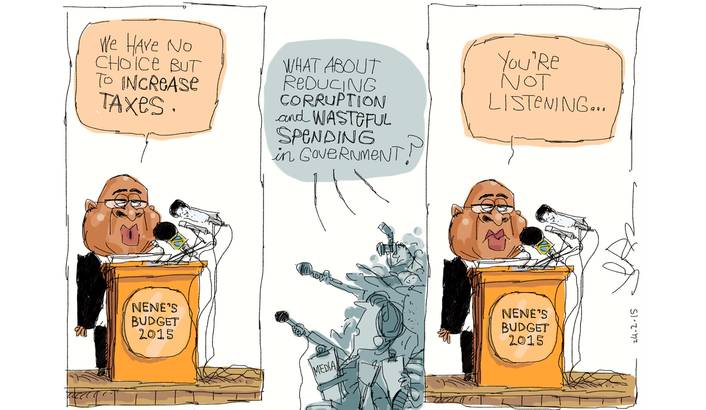
Tonight’s announcement by President Zuma that he has fired Nhanhla Nene as Finance Minister is a reckless and dangerous move that further damages our country’s economy. Accompanied by no reasons for such a drastic move, one can only conclude that tonight’s action is yet another example of how President Zuma puts himself first and the country second.
It is common knowledge that Nhanhla Nene sought to reign in excessive government spending and was causing too much of a blockage for President Zuma in respect of the nuclear procurement deal and SAA. President Zuma has made one thing very clear tonight: if you stand in my way as Finance Minister and seek to introduce fiscal prudence, you will find yourself redeployed and cast aside. A Zuma ANC government has no regard for sensible finance policy that puts South Africa first.
Tonight’s firing of Nhanhla Nene has already had profoundly negative effects on the rand which has plummeted since news of the announcement broke. This is sure to make the plight of the unemployed in South Africa even more difficult.
The appointment of David van Rooyen as Finance Minister provides no assurance that our economy is in safe hands. The fact that President Zuma waited until after last Friday’s rating assessments to make this decision shows that he knew this was a bad decision.
By President Zuma’s own admission, Mr Nene “has done well […] during a difficult economic climate, so it makes absolutely no sense for him to be fired. President Zuma has again proven himself to be a President incapable of making the right decisions to set South Africa on a path to increased economic growth and job creation.
At this time, our country requires strong economic leadership. Tonight’s decision is the complete opposite.
As the DA, we will subject Minister van Rooyen to close oversight as he begins his tenure. And we will intensify our efforts to bring change to South Africa. Change that brings strong leadership and a government that puts South Africa and its people first.
Share this:

“Water: We need to act on the warning signs” – Bokamoso by Mmusi Maimane
Share this:
“Time to liberate ourselves from Zuma’s ANC” – Bokomosa by Mmusi Maimane
Share this:
“President Zuma does not respect our democracy” – Bokamoso by Mmusi Maimane
Share this:
Zwane’s Appointment as Mining Minister is more Zuma Feudalism – Bokamoso by Mmusi Maimane

Share this:

Press Releases on the Coup d’etat in Burkina Faso

It’s been a day with heavy deployment in Burkina Faso. The recent activities are still under way and the reports from the ground and they will continue to come. The Coup d’etat which is happening as we speak is strange especially thinking about the recent process that the nation has been under in recent months. That the military has all of a sudden carried out! The releases that are released are from certain big organization, multilateral organization and bigger nations that have a say in the world.
African Union statement:
“The Chairperson of the Commission of the African Union (AU), Dr. Nkosazana Dlamini-Zuma, continues to follow with deep concern the situation in Burkina Faso following the abduction yesterday, in Ouagadougou, of the President of Faso, Michel Kafando, Prime Minister Yacouba Isaac Zida and some members of his Government, by elements of the
Régiment de sécurité présidentielle (RSP), as well as today’s announcement of the appointment of “new authorities” (…)”She welcomes the unanimous condemnation by the international community of these acts, which constitute a serious threat to peace, stability and security in Burkina Faso, the region and the rest of the continent. She calls on all the AU Member States and the international community as a whole to ensure that this attempt to undermine the Transition is defeated. The AU considers the announcement by the military of the “dismissal” of President Michel Kafando and the attempt of substituting him with “new authorities” as null and void” (…)”The Chairperson of the Commission reiterates the imperative for the defense and security forces to operate under the control of the political authorities. She stresses that the repeated destabilization attempts by elements of the RSP since the beginning of the Transition highlight the need for security sector reform in Burkina Faso, as part of the efforts to deepen democracy and strengthen the rule of law in this country” (African Union, 2015).
Amnesty:
“The situation in Burkina Faso is deeply worrying. The interim president and all those detained must be immediately freed and their physical integrity protected,” said Gaetan Mootoo, Amnesty International’s West Africa Researcher” (…)“The security forces must respect the right of the population to protest peacefully, and take action to avoid any more deaths or injuries,” (…)”The coup d’état comes just two days after the National Reconciliation and Reforms Commission recommended that the RSP be disbanded following accusations that its guards opened fire on unarmed protesters during last year’s anti-government protests” (Amnesty, 2015).
Freedom House:
“The Presidential Guard’s decision to detain key members of the transitional government weeks before the election is a direct threat to Burkina Faso’s transitional process,” said Vukasin Petrovic, director of Africa programs. “It is imperative these officials be released and citizens of Burkina Faso be given the opportunity to peacefully vote for their new government” (Freedom House, 2015).
South Africa;
“South Africa strongly condemns any attempt to seize power through extra-constitutional means or the resolution of political disagreements through the use of force. This incident is a serious violation of Burkina Faso’s Constitution and the country’s Transitional Charter. South Africa calls for the immediate release of Interim President Kafando, Prime Minister Zida and other leaders, and appeals to the people and all political leaders in the country to refrain from any violent activities that may further undermine peace, security and stability in the country. We urge all involved, including Burkina Faso’s security forces, to adhere to non-violence, and to debate issues in a peaceful and inclusive manner” (RSA, 2015).
United Nation:
“The United Nations stands firmly behind the transitional authorities and President Kafando. The Secretary-General notes the strong support of the people of Burkina Faso for a peaceful transition and urges compliance with the transitional calendar, including the upcoming elections.”(United Nation, 2015).
U.S. Statement:
“The United States strongly condemns any attempt to seize power through extra-constitutional means or resolve internal political disagreements using force” (Kirby, 2015).
On a total different note:
“today confirms that operations at its Mana Mine in Burkina Faso have not been interrupted by the coup d’état that erupted yesterday in the Ouagadougou area” (…)”The Mana Mine is located 270 kilometers southwest and a five-hour road trip from the capital of Ouagadougou. We are closely monitoring the situation with our partners to ensure the continued safety and security of SEMAFO employees” (La Valliere, 2015).
Afterthough:
Hope this was some insights and hope when it has transgressed over the recent day. I have nearly ever read that governments and human rights organizations have been positive to a coup d’etat in any country. So that they are telling and condemning of the actions of the military should been seen as reasonable in any sense. The process of the matter and the reactions is normal. I and other just pray that this lead to security and safety for the public. The Burkinabe should get political and economic freedoms that they deserve, because there to many coup d’etat’s in the country. If they get this by yet another coup d’etat we cannot be sure of. That this will generate wealth or generate any kind of stabile government is not certain. Especially when they jail the ones that we’re leading the transitional government that was in place for the moment and time. And the outcome of this will lead to outrage and issues between the public and the new military government. The issues between the Burkina Faso and the outside world will also be in jeopardy and the legitimacy of the government would be hard task. Reasons for the coup and knowledge will be dropped later and the stories behind will surface. For now we will hope and pray that this will lead to something good. Though it’s hard to know since the ones grabbing guns and taking it by force isn’t often a way to a healthy democracy or peoples republics. The last one who stepped aside and made a difference this way was Ghana’s Jerry Rawlings. But he is a rarity in this world. Peace.
Reference:
African Union – ‘THE AFRICAN UNION REJECTS AS NULL AND VOID THE ANNOUNCEMENT BY THE MILITARY OF THE “DISMISSAL” OF THE PRESIDENT OF THE TRANSITION IN BURKINA FASO’ (17.09.2015) link:http://www.peaceau.org/uploads/auc-press-release-burkina-faso-17-9-2015-.pdf
Amnesty- ‘Army must free detained leaders in Burkina Faso and avoid violent repression of protests’ (17.09.2015) link: http://www.amnestyusa.org/news/press-releases/army-must-free-detained-leaders-in-burkina-faso-and-avoid-violent-repression-of-protests
Kirby, John – ‘Recent Actions by Elements of the Presidential Guard in Burkina Faso’ (16.09.2015) link: http://www.state.gov/r/pa/prs/ps/2015/09/246990.htm
LaValliere, Robert – ‘Business as Usual at SEMAFO’s Mana Mine in Burkina Faso’ (17.09.2015) link: http://www.canadianminingjournal.com/press-releases/story.aspx?id=1003706346
Freedom House – ‘Burkina Faso: President and PM Detained Ahead of Vote’ (16.09.2015) link: https://freedomhouse.org/article/burkina-faso-president-and-pm-detained-ahead-vote
RSA – ‘South African Government expresses concern over the Republic of Burkina Faso’ (17.09.2015)
UN – SG/SM/17080-AFR/3208: ‘Outraged over Reported Detention of Burkina Faso Leaders, Secretary-General Calls for Immediate Release’ (16.09.2015) link: http://www.un.org/press/en/2015/sgsm17080.doc.htm

 MinBane